
How Much Should a Newborn Eat? A Week-by-Week Feeding Guide for the First 2 Months

If you've found yourself scrolling at 2 a.m. wondering whether your baby just ate enough — or too much, or too little, or whether you should wake them up for the next feed — you are in extremely good company. "How much should a newborn eat?" is one of the most-Googled questions of early parenthood, and for good reason. The answer changes almost every week for the first two months.
This guide walks you through a typical newborn feeding schedule from birth through 8 weeks, with rough amounts and frequencies for both breastfeeding and formula feeding. Treat the numbers as gentle reference points, not strict rules — every baby is different, and your pediatrician is your best source of personalized advice.
The Quick Answer
In the first two months, most newborns eat every 2–3 hours, which works out to roughly 8–12 feedings per 24 hours. The amount per feeding grows steadily as your baby's stomach stretches:
- Day 1: Up to ½ oz per feeding
- Week 1: 1–2 oz per feeding
- Week 4: 3–4 oz per feeding
- Week 8: 4–5 oz per feeding
That's the short version. Below is the week-by-week breakdown, plus what to watch for at each stage.
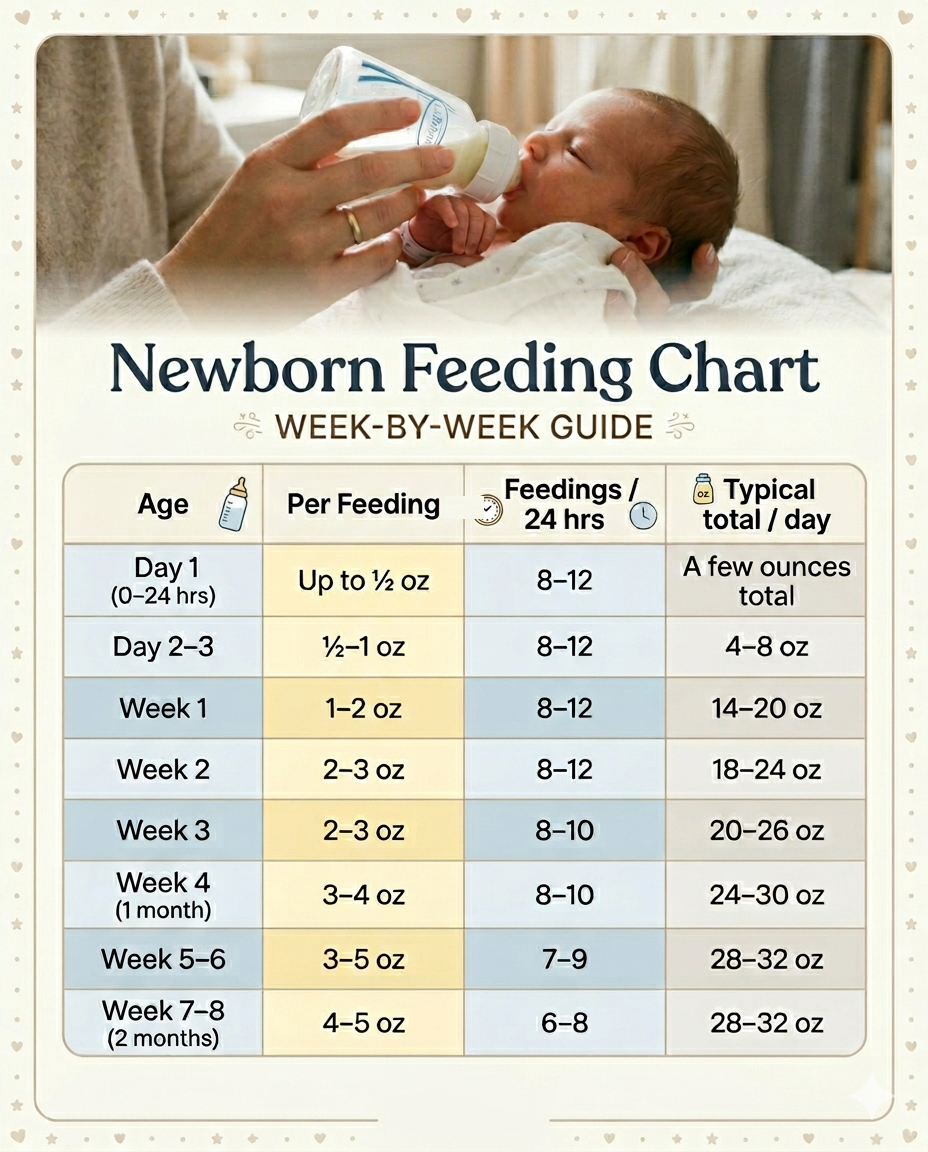
Week-by-Week Newborn Feeding Chart
| Age | Per feeding | Feedings / 24 hrs | Typical total / day |
|---|---|---|---|
| Day 1 (0–24 hrs) | Up to ½ oz | 8–12 | A few ounces total |
| Day 2–3 | ½–1 oz | 8–12 | 4–8 oz |
| Week 1 | 1–2 oz | 8–12 | 14–20 oz |
| Week 2 | 2–3 oz | 8–12 | 18–24 oz |
| Week 3 | 2–3 oz | 8–10 | 20–26 oz |
| Week 4 (1 month) | 3–4 oz | 8–10 | 24–30 oz |
| Week 5–6 | 3–5 oz | 7–9 | 28–32 oz |
| Week 7–8 (2 months) | 4–5 oz | 6–8 | 28–32 oz |
Sources: American Academy of Pediatrics, HealthyChildren.org, and major pediatric guidance from Healthline and Parents.
What's Happening Each Week
Days 1–3: The Tiny-Stomach Stage
In the first 24 hours, your newborn's stomach is about the size of a cherry. Tiny amounts of colostrum (or formula) are exactly right. Many babies are sleepy in the first day or two — gentle waking every 2–3 hours to offer a feed is normal advice from most pediatricians.
What to watch: wet diapers (at least one in the first day, building up from there) and steady weight gain after the initial post-birth dip.
Week 1: Cluster Feeding Begins
Welcome to cluster feeding — short, frequent feedings bunched close together, often in the evenings. It's exhausting, it's completely normal, and it's how breastfeeding mothers build supply. Feedings can last anywhere from 15 to 60 minutes. Both breastfed and formula-fed babies typically take 8–12 feedings per day this week.
What to watch: 6+ wet diapers per day by the end of the first week is a good sign of adequate intake.
Weeks 2–3: Finding a Rhythm (Sort Of)
Most babies are back at their birth weight by 2 weeks and start gaining steadily. Feedings still happen every 2–3 hours, but you may start to see early patterns emerge — longer stretches, slightly larger volumes.
What to watch: weight gain of roughly 5–7 oz per week is typical for this stage.
Week 4 (1 Month): The First Growth Spurt
Around 3–4 weeks, many babies hit their first growth spurt. They suddenly want to eat more often again — sometimes feeling like a return to newborn cluster feeding. It usually lasts 2–3 days. If you're breastfeeding, this is your body's signal to make more milk. If you're formula feeding, you may need slightly larger bottles.
Weeks 5–6: Daytime Stretches Get Longer
Many babies start taking longer stretches between daytime feeds — sometimes up to 4 hours. Overnight stretches may also lengthen, though "sleeping through the night" is still weeks away for most.
Weeks 7–8 (2 Months): Bigger Bottles, Fewer Feeds
By 2 months, the typical pattern shifts to fewer, larger feedings — about 6–8 per day at 4–5 oz each. Another growth spurt is common right around the 2-month mark, so don't be surprised if your baby is suddenly hungrier for a few days.
Breastfeeding vs. Formula Feeding: Quick Notes
Breastfeeding: Direct nursing makes measuring volume difficult — and that's okay. Watch output (wet and dirty diapers), weight gain, and your baby's contentment after feeds. Most breastfed newborns nurse for 15–40 minutes per session.
Formula feeding: You can see exactly how much your baby takes, which can be reassuring. A common guideline: 2.5 oz of formula per pound of body weight per day, divided across feedings. So a 10-pound baby would take about 25 oz per day.
Combo feeding: Many families do both. Your pediatrician can help you find a rhythm that works.
Hunger Cues vs. The Clock
The most reliable feeding "schedule" in the first 2 months is your baby's hunger cues, not the clock. Watch for:
- Rooting (turning head toward your hand or chest)
- Sucking on hands or fingers
- Smacking lips
- Fussing or restlessness before full crying (crying is a late hunger cue)
Feed on demand whenever possible. The numbers in the chart above are descriptive, not prescriptive — they describe what most babies do, not what your baby has to do.
When to Call Your Pediatrician
Reach out to your pediatrician if you notice:
- Fewer than 6 wet diapers per day after the first week
- No weight gain (or weight loss) after the first 2 weeks
- Refusing multiple feeds in a row
- Excessive sleepiness or difficulty waking for feeds
- Persistent spitting up, vomiting, or signs of pain after feeding
These can have simple explanations — but they're worth a quick call. Trust your gut. You know your baby better than any chart does.
A Note on Tracking Feeds
In the foggy first two months, most parents tell us the hardest part of feeding isn't the feeding itself — it's remembering. "When did she last eat? Which side? How long?" Those questions get asked roughly 8,000 times in the first month.
This is exactly why we built Babbl Baby. Instead of tapping through forms during a 3 a.m. feed, you just tell the app what happened in plain language — "Mia had 3 oz at 2:15" — and it logs the time, amount, side, and any notes automatically. It also keeps the running totals you'll be asked about at every pediatrician appointment: feedings per day, ounces per day, time since last feed.
If a feeding tracker would make these weeks even slightly easier, Babbl Baby is completely free on iPhone and Android.
You're Doing Great
If you read this entire post in one sitting at 3 a.m., you are exactly the kind of parent whose baby is doing fine. Use the chart as a reference, watch your baby more than the clock, and remember that every week brings a slightly new normal.
Take a breath. The hard part of these weeks is also the short part.
For more on choosing a tracker that won't add friction to those late-night feeds, see our comparison of Babbl Baby, Huckleberry, and Baby Daybook.